

Subcontractors under the Construction Industry Scheme (CIS) may be:
- Individual self-employed workers (e.g., plumbers, roofers, electricians).
- Small limited companies or partnerships.
- Other independent businesses providing construction services.
These individuals or entities are engaged by contractors to carry out specific elements of construction work—such as site preparation, installation, repair, or decoration. They operate independently, often under their own business name, provide their own tools and materials, and may even hire others to assist in delivering the work.
Payment Structure under CIS:
Subcontractors are paid based on the terms agreed in their contract. Payments may be:
- Milestone-based – e.g., after completing a defined phase of work.
- Upon completion of the subcontracted task or portion of the project.
Interim invoices are common; apply CIS to each payment at the point it’s made.
CIS deductions are calculated on the labour element only (exclude VAT and allowable materials).
To ensure correct tax treatment:
- All subcontractors (including individual self-employed workers) must register with HMRC under the Construction Industry Scheme.
- Once registered, payments will have 20% CIS tax deducted at source (or 30% if not registered).
- Subcontractors with Gross Payment Status may receive full payment with no deduction, subject to HMRC approval.
Important Compliance Note:
Before engaging any worker under CIS, the contractor must:
- Confirm the work qualifies as “construction operations”.
- Assess employment/engagement status. For individuals, apply the usual status tests (control, substitution, mutuality of obligation). Where the agency rules (ITEPA s44) apply because the worker is under SDC by any person, PAYE must be operated. If the individual is an employee, use PAYE, not CIS.
- Verify the subcontractor’s registration status with HMRC.
- Maintain appropriate contracts that reflect a self-employed relationship.
Verify each subcontractor with HMRC before first payment and re-verify if details change.
CIS Responsibilities for Contractors:
Contractors who engage subcontractors under CIS have specific legal obligations:
1. Verify Subcontractors
Before making any payments, contractors must verify each subcontractor with HMRC. This determines the correct CIS deduction rate:
- 20% for verified subcontractors.
- 30% for unverified subcontractors.
2. Report Payments to HMRC
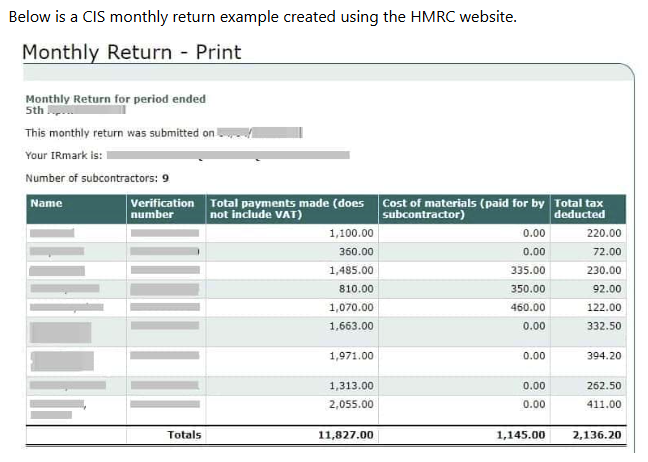
Contractors must submit a CIS300 monthly return by the 19th following the tax month (6th–5th) detailing:
- Total payments made to each subcontractor.
- Tax deductions applied under CIS.
3. Provide Deduction Statements
For every payment where CIS tax is deducted, the contractor must issue a CIS deduction statement to the subcontractor by the 19th following the tax month.
This must include:
- Gross amount paid (labour only).
- Cost of materials set off (if any).
- CIS deduction (20%/30%).
- Net payment.
- Contractor name and tax month; verification number where the 30% rate is used.
These statements provide essential transparency and help subcontractors manage their tax affairs.
CIS Subcontractor Remittance: A compliant CIS remittance statement provides the subcontractor with a full breakdown of the above items.
For companies with Gross Payment Status, make no deduction but keep evidence of GPS and continue to file CIS300.
Remittance statements must be clear, accurate, and issued regularly.
Why Compliance Matters
Providing detailed and accurate CIS remittances:
- Supports transparency and trust in the supply chain.
- Ensures subcontractors can reconcile their tax records.
- Helps contractors avoid penalties, disputes, and reputational damage during HMRC inspections or audits.
Self-Certification Audit
At this stage in the course, you are encouraged to download the self-certification audit document. This tool will help you:
- Take notes throughout the module.
- Prepare for your own CIS compliance self-assessment.
- Evaluate both your internal processes and your suppliers’ adherence to CIS requirements.